Twelve Days in the Range

Our twelve day mountaineering course was a blast! We learned so much and had so much fun! We spent our twelve days in an area of the Alaska Range called Little Switzerland. We camped and based all our travels from the Pika Glacier. For the first nine days it mostly snowed and/or rained. The sun broke through occasionally. But, the last two days were nothing but sunshine and it was hot and brutal. We applied so much sunscreen and still got tons of sun on any exposed skin. We had to be careful not to leave our mouths open too long while walking on the glacier because the roof of your mouth would get sunburned. No joke, it's painful, so we hear. All in all it was not that cold or we never got cold. It was probably between 30 and 40 during the day, expect on those sunny days, and down in the lower 20s or teens at night. We slept toasty warm and sweated most of the day. We ate extremely well! We had hashbrowns (with ham and cheese), pancakes, bagels (with lots of butter and cream cheese), oatmeal, granola, nuts, dried fruit, dry snack mixes, tons of pasta, rice, cous cous, dehydrated chicken, and had all sorts of sauces and spices to use. It was all delicious! We spent a lot of time cooking, learning how to winter camp comfortably, and how to take care of ourselves there. We had an awesome group of people to work with and get to know. Overall, it was a great experience!

All these pictures are a combination of ours and other team members that have been shared.

Just landed and full of excitement!

We carried all of our stuff about 300 yards away from the airstrip and set up camp.

The rock formation in the background is called The Trolls.

Our two (soon to be three) snow kitchens with group gear (shovels, pickets, fuel, ropes) sitting in the foreground.

Looking down glacier at camp.

The snow bathroom--about a five foot square hole in the snow with stairs leading into it.

Our snow kitchen! We have a bench seat with an island in the middle. Eventually I carved a shelf into the island for pots and pans.

We shared the kitchen with our tentmate, Adam, on the left and the three air force guys on the right.

One of the other snow kitchens.

Andrew and I with one of our guides, Matt.

Camp on a nice, sunny day.

Camp on a dark, snowy day.

Camp with descent visibility.

Camp with no visibility.

Mt. Foraker, 17,000+ ft., could be seen from our camp.


A couple of other shots from camp.


Nice evening light.
~
During the first few days we learned a lot of things at camp. Here we are learning how to build an anchor for a crevasse rescue. When someone falls into a crevasse the rest of the team falls into the self arrest position to tighten/hold the rope. Then, you immediately build an anchor to safely transfer the load of that person onto the anchor so you can then pull the person out or they can ascend out themself (ideally).

An anchor is two points of protection connected with cord an a low angle. We learned a couple of different ways to build an anchor depending on the condition of the snow. This one is the more sturdy way.

Andrew ready to build an anchor.

Here we are testing one point of protection.
~
The first day going out for a tour.


Taking a break, hanging out.
~
Another tour the next day in a different direction.


Walking by a big crevasse!

My rope team went to a different overlook from Andrew's.


~
The next day we headed up the hill behind our camp, below the Trolls, to a huge open crevasse to practice crevasse rescue.


Andrew walking behind me.

Waiting on the guides to probe/feel for crevasses (with a 12 ft. collapsible pole) in the area to make sure it's indeed safe.

Andrew and I got to rescue each other. I found out how heavy he really is. I am building my anchor and pulley system above.
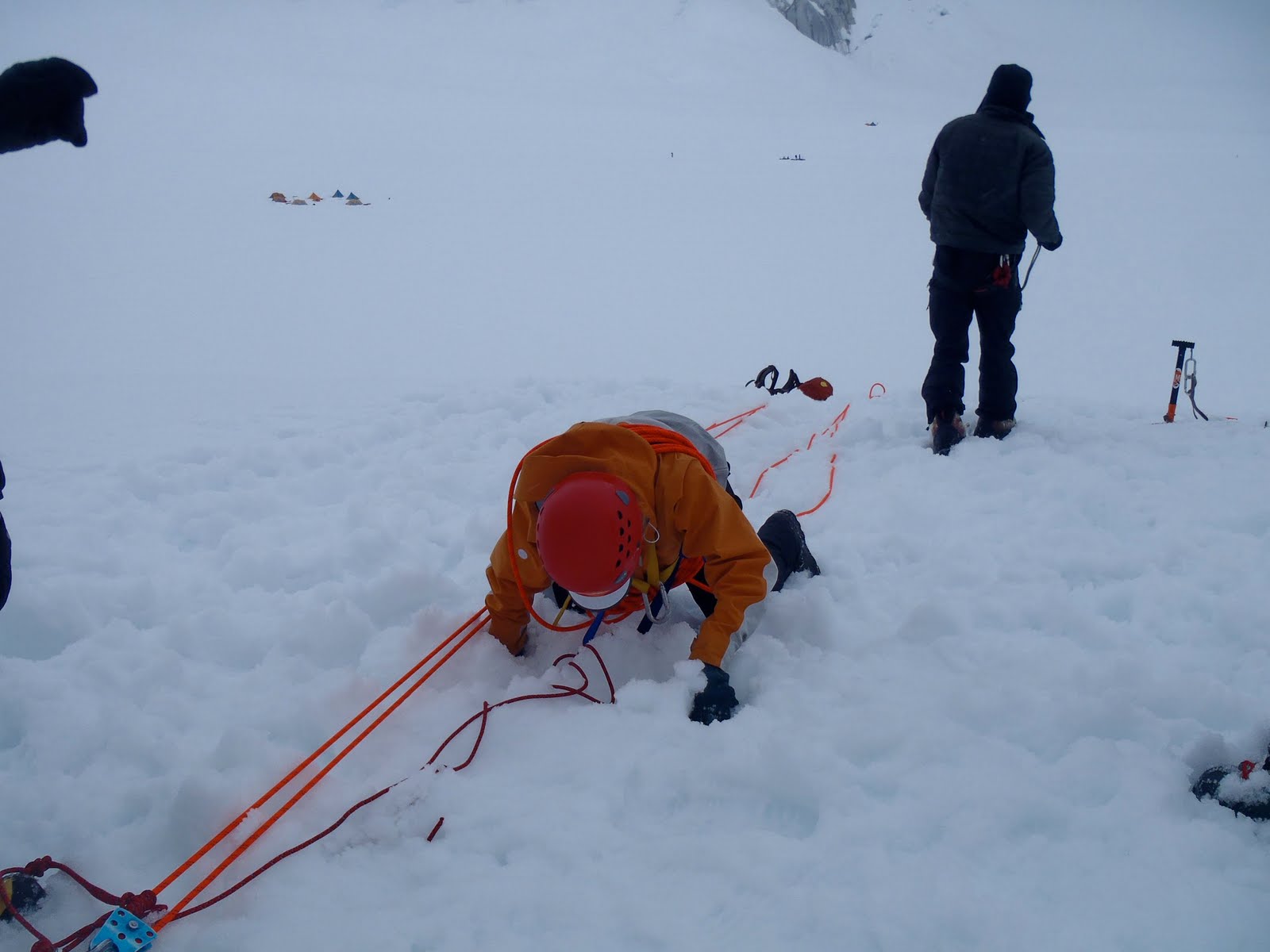
Here I'm trying to pull him out.


This is me hanging out (literally) in the crevasse waiting on Andrew to rescue me.
~
The next day we went back up to the crevasse to practice ascending and rappelling.


An ascender.

Andrew ascending his way up.


The top part or the lip of the crevasse is the hardest to get up and over.

My turn!


At the end of the day we did some ice climbing. We didn't really get any pictures. This guy is being silly on his way down. But you are wearing crampons and using two ice climbing tools which are basically ice axes with an attitude (curved handles and huge gnarly teeth).
~
We moved camp on day 7. We loaded everything into our backpacks and sleds and hauled it into a glacial alcove a few miles away. We had to make our way up an ice fall (where the glacier flows at an abrupt, steep angle downhill) and over snow bridges.

The sled. The longer rope hanging down attached to a strap lashed at the bottom of our backpacks. The yellow rope was used for a brake when going down hill (it just dragged underneath the sled) and was tucked out of the way when going uphill. The little, but long, white cord bundled up at the top was used to tie everything securely on the sled.

Almost ready to go.

Headed out.

The sleds would slide sideways down the hill and tug on your backpack. Sometimes it would roll over.


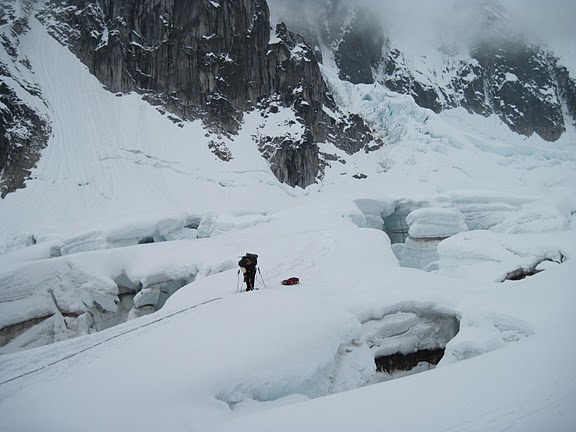

Chuggin'


Once we got to where we thought would be a good camp--out of avalanche danger, a couple of people would check it by probing the area.


We did see lots of avalanches throughout the day. It had warmed up that day and all the fresh snow that we had gotten over the last nine days was coming down.

Before you set up your tent, you pack the snow down and level it out.


Our new camp for two nights!

Then we began digging/building a snow kitchen.

Enjoying camp, new scenery, and hot coco!


Keeping warm in our big parkas!


Using the snow bathroom.

This is funny. This young guy from Saudi Arabia, dug a nice little hole in the snow one night as we were standing around talking. Then, one of the air force guys bet him that he couldn't fit into it. When he stepped into to it to show him he could, the guys quickly started filling the hole up with snow. He was really stuck for a while. At the end of it, they gave him a shovel to use with his one free arm to dig himself out. It was quite entertaining!


~
The next day we went up the hill to learn the four ways to move into the self arrest position.


~
Moving back to our original camp location near the airstrip. To get everything down the ice fall we had to make two different trips. We carried one huge load down in our backpacks first, then emptied it at the bottom, and went back for the second load.


There's Andrew.


When we went back for our sled load we literally stuffed the entire sled in our backpacks.

~
Day 10
We walked down below firn line (where blue ice/bare glacier meets seasonal snow) to practice crampon climbing techniques.

We went just to the left of the bottom of this glacier.

This was the only day all week that someone unintentionally fell into a crevasse. He only fell in waist to chest deep (the rope tension caught him) and crawled right out.

The sun finally came out for a whole day and it was hot!


The stuff shown in the picture below is what we were practicing on. It looks like rock but it's solid ice with small rock pieces and dust on top.

The most bizarre thing happened while practicing the fixed line ascension (shown above). One of the guides spotted a bear! It took a moment to process what he was saying and actually believe him, but it was true. It rarely happens but there was a bear walking across the glacier. We watched it till we couldn't see it anymore. We think he/she made it safely. We watched it walk into crevasses and out the other side, sometimes walking the length of them. It was absolutely amazing.

The little black dot in these two photos is the bear!


The bear tracks.

~
Day 11--Rock Climbing

We were heading towards the closest looking rock on the left in the picture.

Looking across the glacier at the ice fall that we climbed up a day or two before. We went up the right side of it---through the more solid looking section.

Leighon was climbing up fixing the ropes.

Andrew is waiting patiently.

Dusty, one of our guides.

Excited for the climb!

I was belaying Andrew.


Andrew going up!


Me climbing up!


Rappelling down!

Our lead guide, Leighon.
~
Later that evening...

Getting ready for a group photo.


Best group shot!

Unexpectedly, two friends of our guides flew out on some personal time for rock climbing the night before we left. One of our guides decided to do one peak with them before we left. They went up to the top of the Middle Troll.

They made it to the top!

Summer Solistice...11:30 pm, the night before we flew back to Talkeetna.

Back at AMS...drying everything out, returning rental stuff, using a flush toilet and running water, and soaking up the green (you really start to crave green things like grass and trees when you see nothing but white for a long time).

Into the Mountains

Climb the mountains and get their good tidings. Nature's peace will flow into you as sunshine flows into trees. The winds will blow their own freshness into you, and the storms their energy, whiles cares will drop like autumn leaves.
~John Muir

Today, Andrew and I are flying out of Talkeenta, AK, with guides from Alaska Mountaineering School to begin a twelve day mountaineering course. We do like adventure, but we like to feel safe and in control during the adventures. So, we are investing some time and money to be trained by professionals to gain the experience and knowledge to do so. We will be flying into a remote area of Denali National Park. This area will be picked by the instructors two days prior to take-off based on snow conditions. The course consists of nine students and three instructors. During the course we will be learning (by doing) glacial travel, self arrest with ice axe, crevasse rescue, rock and ice climbing, winter camping skills like selecting a campsite and learning how to build a snow cave and igloo, and most importantly learning and practicing safety and judgement with terrain, weather, and your personal skill levels.

We should be able to take our Spot tracking device with us, so you can keep up with our location that way.

Plus, AMS keeps a blog that they update when they receive updates. They go with the saying "no news is good news."

I will give a detailed update when we return.

There are old climbers and there are bold climbers, but there are no old, bold climbers.
~Paul Petzoldt

Cassiar Highway

The Cassiar Highway is a 450 mile north/south highway in British Columbia that connects the Yellowhead Hwy. and the Alaska Hwy. Unlike the Alaska Highway it stays on the west side of the Canadian Rockies. This was our third time driving it. We love the scenery and the remoteness of it. In the Milepost (the highway guide we use) there's about a twenty mile section that has a note about watching for bears at least every half mile or so. In this section we saw six bears (five blacks and one grizzly) in twenty minutes along or near the road sides.


This was the best black bear picture that we got. The grizzly cub below was extremely photogenic and close to the road. It was very nice of him/her to stand in the dandelion section for us also.


What a cute bear! We sat and watch him/her for about ten minutes.

First Two Weeks in Alaska

We arrived just two weeks ago and have already accomplished quite a bit. We got right to work helping cousins, George and Leslie, build their new house. Everyday the look and feel of the work site changes. We are loving getting to see this piece of work go from the ground up. Also, Andrew and I have been running or hiking with weighted backpacks almost everyday we've been here preparing for the mountaineering course we are about to start. As far as Alaska itself, the interior had a very mild and dry winter. Except for the last few days, the summer has started out to be just has dry. Fairbanks hit record breaking temperatures a few days after we arrived. Thermometers recorded several days in the upper 80s and low 90s the last week of May. Trees were green when we arrived, but a few rivers and lakes were still surrounded with ice. The wildflowers having been popping out since our first day here. It started with the blue bells and lupine, then labrador tea, arnicas, wild roses, mountain avens, wild geranium and many others have followed. The only downside so far is the dry weather. The newspaper has reported that fuel levels (in the woods) have reached a historical maximum. That combined with the third lowest winter snowfall and also a very mild winter is not a good combination. The spring started with two wildfires that were still burning from last summer. They got into the moss and made it through the winter. A few new wildfires have started in the two weeks we've been here due to thunderstorms that have brought lots of lightning and very little rain. We are praying for rain. Thankfully, a steady rain fell for about 36 hrs. over the weekend and on and off for several days before and after. It has helped some but not completely.

Eklutna Lake

Our first night in the Anchorage vicinity was spent at Eklutna Lake, part of the Chugach State Park. We camped there one night and did some hiking the next day. All but one of the trails were closed due to a couple of small forest fires.

On the way down we saw a few caribou which quickly ran away when we pulled over to watch them.

The trail that was once an old road bed. We love the trails wide enough for of all three to walk together.

Some fine lupine along the trail.

Our first view of Eklutna Lake.

You can see the smokey haze at the back of the lake.

In this picture you can see the stream of smoke coming from one of the fires.

The destination viewpoint was Twin Peaks.
This is where the maintained trail ended and a couple of unmaintained trails branched off to go to the top of the peaks or a mountain pass. We stopped at this point and headed back down because we had a mission in town to attend.

We counted about thirty Dall sheep over on the rocky slopes of the Twin Peaks.

Headed back down for another look at the lake.

It sure was a beautiful trail and a gorgeous day! The weather is a little cooler down toward the coast. Temps were in the 70s as opposed to the upper 80s and lower 90s of the interior.

A Week with Didier

Andrew and I received an amazing offer from a good friend and professional wildlife photographer, Didier Lindsey, last summer. Basically, he said if we had time to spend with him this summer he would show us the ropes and help get us started in our photography business. Our second week in Alaska we drove down to Anchorage to get together with him and begin some schooling. What an amazing asset he has been already. So much knowledge it's almost overwhelming. He is an incredible photographer and teacher. It is such a pleasure getting to hang out with him in the field. And a huge bonus---his lovely wife cooked incredible meals for us all week!

We visited Potter's Marsh on the Turnagain Arm several times during the week. There is always something going on down there, and it's always a challenge.

Nice light on this Canada Goose.


Blue-billed Ducks

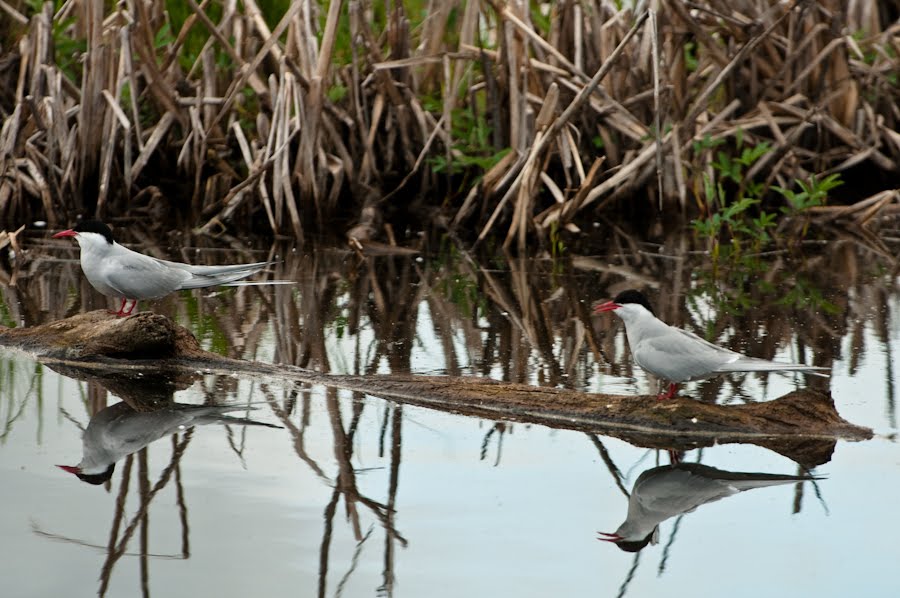
Arctic Terns were the most challenging to take pictures of. They are such graceful birds, full of life and speed.


They would hover over their nests before landing. I really wanted to get a nice, crisp picture of it but was not quite lucky enough.


A muskrat swimming by.

More terns with their reflections.


The first seen (by us) gosling of the year.

Mew Gull attack!
The geese are obviously swimming too close to its nest.

Mew Gull eggs and nest.


~
Didier said he would take us to shoot photos of a moose.

And he did! This man knows his areas.

~
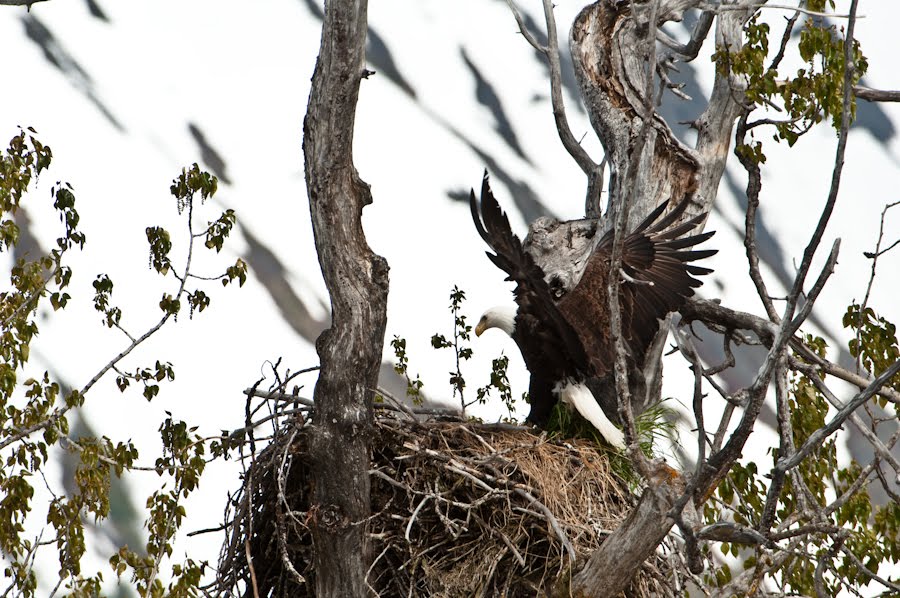
He also took us to an eagles nest.


~
This was an unexpected surprise. On the way home we spotted a kite surfer on the Turnagain Arm. We stopped to get some action shots.


Didier and I...
havin' a good time!
Final shot...the beautiful Chugach Mountains across the Turnagain Arm.